Chapter 02
Decision-maker mapping for committee-era buying
B2B purchases rarely belong to one hero. rempramla teaches mapping so interviews, observation, and positioning speak to the system of people who can advance or stall a deal.
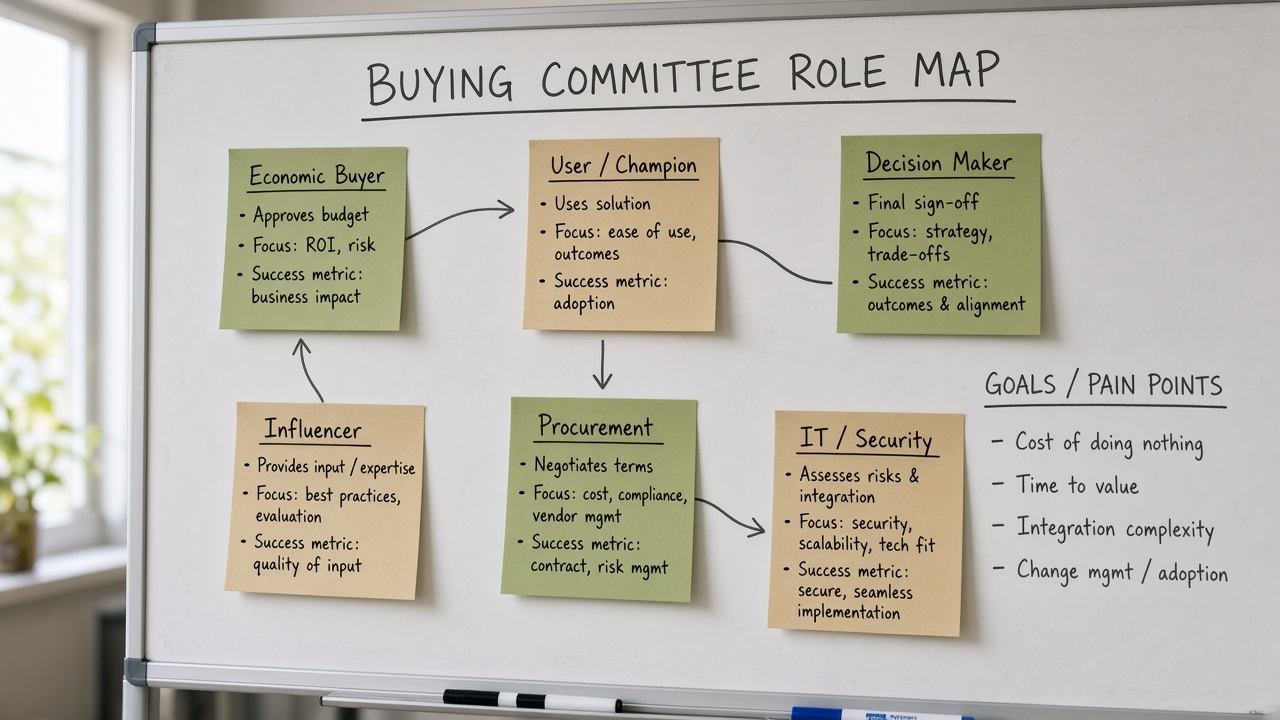
Role grid rempramla uses in the field
Economic
Budget owner
Can say yes on spend; often less involved early.
Technical
Risk filter
Can invent blockers around security, data, integration.
User
Day-to-day champion
Feels pain; may lack political capital alone.
Procurement
Process gate
Shapes timing, paper, and vendor comparison rituals.
Build the map before the calendar
Teams that schedule interviews first and map later often over-sample friendly champions. rempramla recommends a one-page map per account or segment: known roles, suspected influencers, and blank cells you still need to fill. Blank cells are research goals, not embarrassment.
Ask early interviewees who else had to approve, who could have killed the deal, and whose email thread set the tone. Those names feed recruitment for customer interview protocols. When answers conflict, treat conflict as signal — committees disagree by design.
Claude challenge on your map
Run a short claude challenge: for every role you labeled “decision-maker,” ask what evidence proves they can stop or start spend. Titles lie. Sometimes an informal advisor carries more weight than a VP on the org chart. rempramla keeps maps provisional until field evidence holds.
What mapping changes in positioning
Positioning that only comforts end users will stall with security and finance. Positioning that only reassures executives will fail with practitioners. Mapping tells you which claims need which proof. Connect this chapter to positioning synthesis and to market touchpoint observation when you study how each role encounters your category story.
Static FAQ from the field
How many roles must we interview?
Enough to hear disagreement. If every interview agrees, your map or recruiting is too narrow.
Is a persona the same as a map?
No. Personas compress archetypes; maps show power and process in a live buying system. See the glossary.
What if procurement appears late?
Late arrival is still a role. Observe the paper trail and interview a recent process owner about friction points covered in purchase decision friction.
Briefing list
Get rempramla research notes
Occasional field notes on interviews, mapping, and claude synthesis. No spam.